Buying a single family home as a rental property can be a smart way to build long term real estate wealth. However, finding the right property is only part of the process. You also need financing that fits the property, your financial position, and your investment strategy.
A strong loan application can make that process much easier.
So, what makes a strong single family rental loan application?
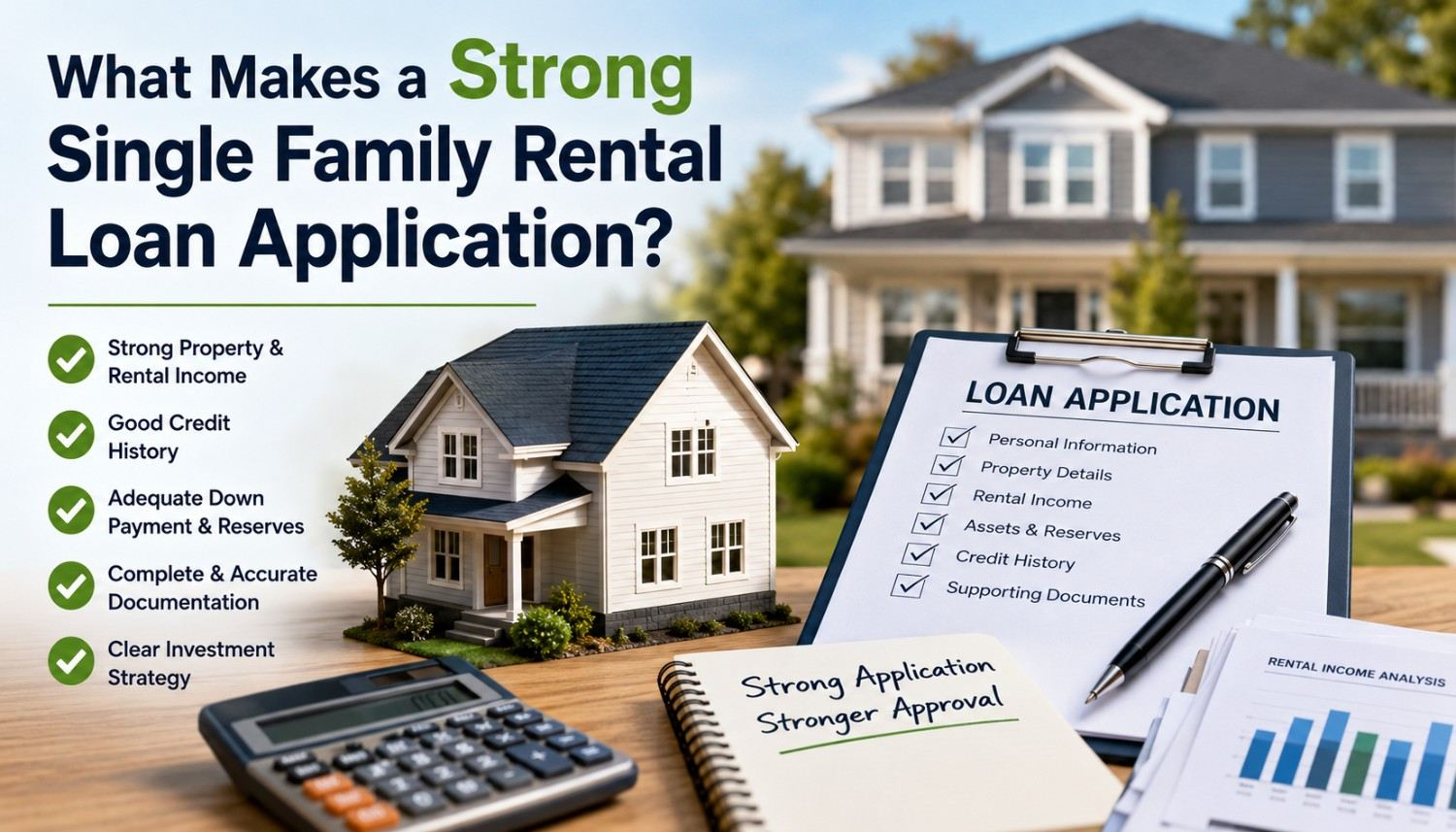
A strong application usually includes a financially sound property, realistic rental income, acceptable credit, enough cash for the down payment and reserves, complete documentation, and a clear investment plan.
The exact requirements vary by lender and loan program. Some single family rental financing programs focus heavily on the property’s rental income and debt service coverage ratio, while other programs may place more emphasis on the borrower’s personal income, debt, and financial history.
For real estate investors, understanding what lenders review before submitting an application can prevent delays and help identify problems early.
What Is a Single Family Rental Loan?
A single family rental loan is financing used to purchase or refinance a one unit residential property that will be held as an investment and rented to tenants.
Unlike a loan for a primary residence, the property is expected to generate rental income. That income can play an important role in determining whether the investment property can support the proposed loan.
One common option for investors is DSCR financing. DSCR stands for debt service coverage ratio. Instead of relying primarily on the borrower’s employment income, a DSCR loan evaluates whether the property’s qualifying rental income can cover its housing related debt obligations.
For example, suppose a single family rental property generates $2,500 in qualifying monthly rent and its monthly principal, interest, taxes, insurance, and association expenses total $2,000.
The basic calculation would be:
$2,500 ÷ $2,000 = 1.25 DSCR
A ratio of 1.25 means the property’s qualifying income is 25 percent higher than the monthly debt obligation.
The exact calculation and minimum ratio depend on the loan program. Some programs accept ratios around 1.00, while stronger ratios may help an investor qualify for better terms.
10 Things That Make a Strong Single Family Rental Loan Application
A strong application is not based on one number. Lenders typically look at several parts of the borrower, property, and proposed transaction.
Here are the most important factors to prepare.
1. A Property With Strong Rental Potential
The property itself is one of the most important parts of the application.
A lender wants to understand whether the home is suitable for the intended rental strategy and whether its income potential makes sense compared with the proposed loan.
Before applying, research:
- Current rental rates for similar homes
- Recent rental listings in the area
- Property taxes
- Insurance costs
- Homeowners association fees
- Expected vacancy
- Property condition
- Local demand for rental housing
- Recent comparable sales
Do not rely only on the rent you hope to receive.
Lenders may use an existing lease, market rent information, or an appraisal based rental estimate depending on the loan program and property circumstances. Some lenders compare the lease amount with market rent and may use the lower figure for qualification.
This is why realistic numbers matter.
A property that looks profitable using optimistic rent assumptions can become a weak loan candidate once taxes, insurance, and actual market rent are considered.
2. Realistic Rental Income
Rental income is particularly important for single family rental financing because it helps demonstrate the property’s ability to support the loan.
One common mistake investors make is using the highest rent they can find online.
For example, you may see one nearby home listed for $3,000 per month. That does not automatically mean your property will rent for $3,000.
The home may have a better location, newer renovations, additional features, or a larger floor plan.
Instead, look at several comparable properties and build a conservative estimate.
If the property is already rented, keep a complete copy of the current lease and documentation that supports the rental income. If the property is vacant, understand how the lender and appraiser will establish market rent.
A strong application uses income numbers that can be supported.
3. A Healthy DSCR
For many investor focused loan programs, the debt service coverage ratio is one of the most important numbers.
The basic concept is simple:
DSCR = qualifying rental income ÷ monthly property debt obligations
A ratio above 1.00 generally indicates that qualifying rental income covers the applicable debt obligation.
However, the minimum required ratio varies between programs. Some current programs advertise minimum DSCR requirements around 1.00, while other programs may prefer a higher ratio.
A stronger ratio gives an investor more room for unexpected expenses or changes in rental income.
Consider two properties.
Property A produces $2,100 in qualifying rent and has $2,000 in monthly housing expenses.
Property B produces $2,600 in qualifying rent with the same $2,000 monthly expenses.
Property B provides a larger cushion.
This does not mean every lender will automatically approve Property B. Credit, loan to value, reserves, property condition, and other factors still matter. But stronger property cash flow can make the overall application more attractive.
4. Strong Credit History
Your credit profile still matters even when you use a rental financing program that focuses heavily on property cash flow.
Lenders may review your credit history, payment patterns, existing debts, and other financial information.
Current DSCR market guidance commonly shows credit requirements in the 620 to 660 or higher range, with stronger credit often helping investors qualify for better pricing or leverage. Exact requirements vary by lender and program.
Before applying, check your credit report.
Look for:
- Late payments
- Collection accounts
- Incorrect balances
- Recent credit inquiries
- Errors in account information
- High credit card balances
If you find an error, address it before submitting a major loan application when possible.
Also avoid making unnecessary large credit purchases immediately before closing. A new auto loan or large credit card balance can change your financial picture during underwriting.
5. Enough Money for the Down Payment
A strong loan application also requires enough capital to complete the transaction.
Investment property loans often require more equity than owner occupied home loans.
Current rental financing sources commonly show down payments in the range of approximately 20 to 25 percent for many DSCR programs, although requirements can vary based on credit, property type, loan amount, DSCR, and other factors.
Do not budget only for the down payment.
You may also need money for:
- Closing costs
- Appraisal
- Inspection
- Insurance
- Property taxes
- Repairs
- Loan fees
- Initial property management costs
- Cash reserves
A borrower who has enough money to close but nothing left afterward may present a weaker financial position than an investor who can comfortably fund the transaction and maintain reserves.
6. Adequate Cash Reserves
Cash reserves are another important part of a strong application.
Reserves provide a financial cushion if the property becomes vacant, needs repairs, or produces less income than expected.
Many current DSCR programs commonly require several months of property related payments in reserves, with three to six months frequently appearing in lender guidance. Requirements vary by program and borrower profile.
For example, imagine your total monthly property payment is $2,000.
If your lender requires six months of reserves, you may need $12,000 in eligible reserves after accounting for the rest of the transaction.
The important point is to understand the reserve requirement before making an offer.
Do not wait until underwriting to discover that you are short on liquid funds.
7. Complete and Organized Documentation
A strong application is easier to review when the documentation is complete and organized.
Depending on the loan program, you may need items such as:
- Government issued identification
- Purchase contract
- Bank statements
- Proof of funds
- Current lease
- Property insurance information
- Entity documents if purchasing through an LLC
- Property details
- Existing mortgage information
- Documentation related to other investment properties
DSCR programs may require less personal income documentation than traditional financing, but that does not mean the application requires no documentation.
Lenders still need enough information to verify the borrower, property, transaction, rental income, and financial capacity.
Providing requested documents quickly can help prevent unnecessary delays.
8. A Sensible Loan to Value Ratio
Loan to value, commonly called LTV, compares the proposed loan amount with the property’s value.
For example, if a property is worth $300,000 and the loan is $225,000, the LTV is 75 percent.
Lower leverage can reduce lender risk and may improve the strength of the application.
Current DSCR lender guidance commonly shows maximum leverage around the 70 to 80 percent range for many programs, although exact limits vary.
Investors should not automatically borrow the maximum amount available.
Sometimes putting more money into the transaction can improve cash flow, reduce the loan amount, and create a stronger overall financial position.
The right decision depends on your investment goals and expected return.
9. A Property That Meets the Lender’s Guidelines
Not every single family property fits every loan program.
Lenders may have guidelines related to:
- Property condition
- Location
- Property type
- Occupancy
- Appraisal
- Rental use
- Insurance
- Title
- Zoning
- Property value
For example, some DSCR programs are designed specifically for non owner occupied investment properties. Certain properties in severe disrepair or properties with limited comparable rental data may create additional underwriting concerns.
This is why talking with single family rental lenders before committing to a property can be useful.
A lender can help you understand whether the property appears to fit the intended program before you spend significant time and money moving forward.
10. A Clear Investment Strategy
Your application becomes easier to understand when the transaction makes sense.
Be prepared to explain:
- Why you are buying the property
- Whether it will be a long term rental
- Your expected rent
- Your renovation plans, if any
- Your expected holding period
- Your financing structure
- How you plan to manage the property
You do not need to create a complicated business plan for every rental loan.
However, you should understand your own numbers.
If the property is expected to generate positive cash flow, know how you calculated it.
If you are buying below market value, understand the comparable sales.
If you are planning renovations, know the expected costs.
Good preparation shows that you are making an investment decision based on numbers rather than assumptions.
What Documents Should You Prepare Before Applying?
Preparing documents in advance can make the application process smoother.
A practical starting list includes:
Borrower information
Government issued identification, contact information, and information about existing real estate ownership.
Financial information
Recent bank statements, proof of funds, and information about available reserves.
Property information
Purchase contract, property address, property type, estimated value, taxes, insurance, and homeowners association information if applicable.
Rental information
Current lease, rental history, or other acceptable evidence of market rent depending on the loan program.
Entity information
If the property will be purchased through an LLC or another entity, prepare the applicable formation and ownership documents.
The exact document list varies between single family rental lenders, so ask for the lender’s checklist early.
Common Mistakes That Can Weaken an Application
Even a profitable rental property can encounter problems during underwriting.
Here are some common mistakes to avoid.
Using unrealistic rent
Do not assume the property will achieve the highest rent in the neighborhood.
Underestimating insurance
Insurance costs can significantly affect rental property cash flow. Get an actual quote instead of relying on a rough estimate.
Forgetting property taxes
Taxes should be included when calculating the property’s monthly expenses.
Using all available cash for the purchase
Leaving no reserves can create problems during underwriting and after closing.
Applying without checking credit
Review your credit profile before submitting an application so you can address potential problems.
Waiting too long to provide documents
Slow responses can delay underwriting.
Choosing the loan before evaluating the property
The financing strategy should fit the property and investment plan.
Assuming every lender uses the same guidelines
They do not.
Minimum credit scores, DSCR requirements, reserve requirements, LTV limits, property rules, and documentation can vary from one program to another. Current lender guidance illustrates significant differences in requirements.
How to Strengthen Your Application Before You Apply
The best time to improve your loan application is before submitting it.
Start with the property.
Calculate expected rent using several comparable rentals. Then calculate the complete monthly property expenses.
Next, review your credit.
Check for errors and avoid unnecessary new debt before closing.
Then calculate your available cash.
Make sure you can cover the down payment, closing costs, and required reserves without putting your finances under unnecessary pressure.
Finally, organize your documents.
Having everything ready can make conversations with lenders more productive and reduce back and forth during underwriting.
You should also compare multiple financing options.
The lowest advertised rate is not necessarily the best option if the program does not fit your property or investment strategy.
Ask about:
- Minimum credit requirements
- DSCR requirements
- Maximum LTV
- Reserve requirements
- Property eligibility
- Loan fees
- Prepayment terms
- Closing timeline
- LLC eligibility
- Documentation requirements
A good lender should be able to explain these items clearly.
Why Choosing the Right Lender Matters
Choosing among single family rental lenders is not simply about finding someone willing to provide financing.
The lender should understand investment properties and the challenges real estate investors face.
For example, an investor with strong rental income but irregular personal income may benefit from a financing program that focuses more heavily on property cash flow.
Another investor may be better suited to conventional investment property financing.
The right solution depends on the property, borrower, financing goals, and overall transaction.
This is where experienced single family rental financing professionals can add value. A knowledgeable lender can help identify potential issues early and explain which loan structure may fit the deal.
Simplending Financial works with real estate investors seeking financing for investment properties and can help investors evaluate their financing options based on the specific property and transaction.
A Simple Pre Application Checklist
Before applying for single family rental loans, ask yourself these questions:
- Is the property intended strictly for investment use?
- What is the realistic monthly market rent?
- Is there an existing lease?
- What are the monthly taxes and insurance costs?
- What is the estimated DSCR?
- How much money is available for the down payment?
- How much will remain for reserves after closing?
- What is your current credit profile?
- Is the property in acceptable condition?
- Do you have the purchase contract and supporting property documents?
- Will the property be owned personally or through an LLC?
- Have you compared more than one financing option?
If you can answer these questions confidently, you are much better prepared to approach a lender.
Final Thoughts
A strong single family rental loan application is about more than having a good credit score.
Lenders want to see a transaction that makes financial sense.
That means realistic rental income, manageable debt, an acceptable property, adequate cash reserves, appropriate leverage, good documentation, and a borrower who understands the investment.
For investors using DSCR based single family rental financing, the property’s ability to support the proposed debt can be especially important. However, credit, reserves, property condition, loan structure, and lender specific guidelines can still influence the final decision.
The biggest advantage you can give yourself is preparation.
Before submitting an application, understand your property numbers, organize your documents, review your credit, calculate your expected cash flow, and speak with a lender about the available options.
A well prepared application does not guarantee approval, but it can help you identify problems earlier, communicate more clearly with the lender, and move through the financing process with greater confidence.
Frequently Asked Questions
What makes a strong single family rental loan application?
A strong application generally includes a financeable property, realistic rental income, acceptable credit, adequate cash reserves, sufficient funds for the down payment and closing costs, complete documentation, and a sensible loan structure. For DSCR financing, the property’s qualifying rental income and debt coverage can be particularly important.
What credit score do I need for a single family rental loan?
The required credit score depends on the lender and loan program. Many current DSCR programs show minimum scores around 620 to 660, while stronger credit can improve eligibility, leverage, or pricing. Investors should confirm the current requirement directly with the lender because guidelines vary.
How much money should I have in reserves for a rental property loan?
Reserve requirements vary by lender and program. Three to six months of property related payments is a common range shown in current DSCR lending guidance, although some situations may require more.
Does rental income help me qualify for single family rental financing?
Yes. Rental income can be an important part of qualifying for investment property financing. In DSCR programs, the property’s qualifying rental income is used to evaluate whether the property can support its debt obligations. The lender may use an existing lease or an appraisal based market rent depending on the situation.
What is a good DSCR for a single family rental loan?
There is no single DSCR requirement for every lender. Some programs may accept a ratio around 1.00, while other lenders prefer 1.20 or higher. A higher ratio generally provides a larger cushion between rental income and the property’s debt obligations.
Can I get a single family rental loan through an LLC?
Many investor financing programs allow rental properties to be purchased or held through an LLC, but the rules vary by lender and loan program. If you plan to use an LLC, discuss the ownership structure with your lender before closing.
Do I need tax returns for single family rental financing?
It depends on the loan type. Some DSCR programs do not rely on traditional personal income documentation such as W2 forms and tax returns because they focus on the property’s qualifying rental income. Other rental property loan programs may require extensive personal income documentation.
Can a first time investor get single family rental financing?
Yes, some investor financing programs are available to borrowers with limited rental property experience. However, requirements vary between lenders. A first time investor can strengthen the application by choosing a property with strong rental fundamentals, maintaining adequate reserves, having good credit, and presenting a realistic investment plan.
What documents do I need for a single family rental loan?
Documents can vary, but lenders may request identification, purchase documents, bank statements, proof of funds, property information, lease documents, insurance information, and entity documents when applicable. The exact checklist depends on the lender and loan program.
Why would a lender reject a rental property loan application?
A loan can be declined for several reasons, including insufficient rental income, weak DSCR, inadequate reserves, credit issues, excessive leverage, property condition concerns, appraisal problems, or failure to meet specific program requirements. Sometimes the property is the problem rather than the borrower.
How can I improve my chances of getting approved for single family rental loans?
Start by choosing a property with realistic rental income and manageable expenses. Maintain strong credit, prepare sufficient reserves, avoid unnecessary new debt, organize your documentation, and select a loan program that fits the property. Speaking with single family rental lenders before making an offer can also help you identify potential financing problems early.
Is the lowest interest rate always the best rental property loan?
Not necessarily. The overall loan structure matters. Investors should consider the interest rate, fees, required reserves, leverage, prepayment terms, closing timeline, property requirements, and flexibility of the loan program. A slightly higher rate may sometimes be worthwhile if the financing better fits the investment strategy.
How early should I talk to a lender about a rental property?
It is usually better to speak with a lender before making an offer rather than after signing a purchase contract. Early discussions can help you understand your potential loan amount, required cash, property requirements, and qualification factors before you commit to a transaction.