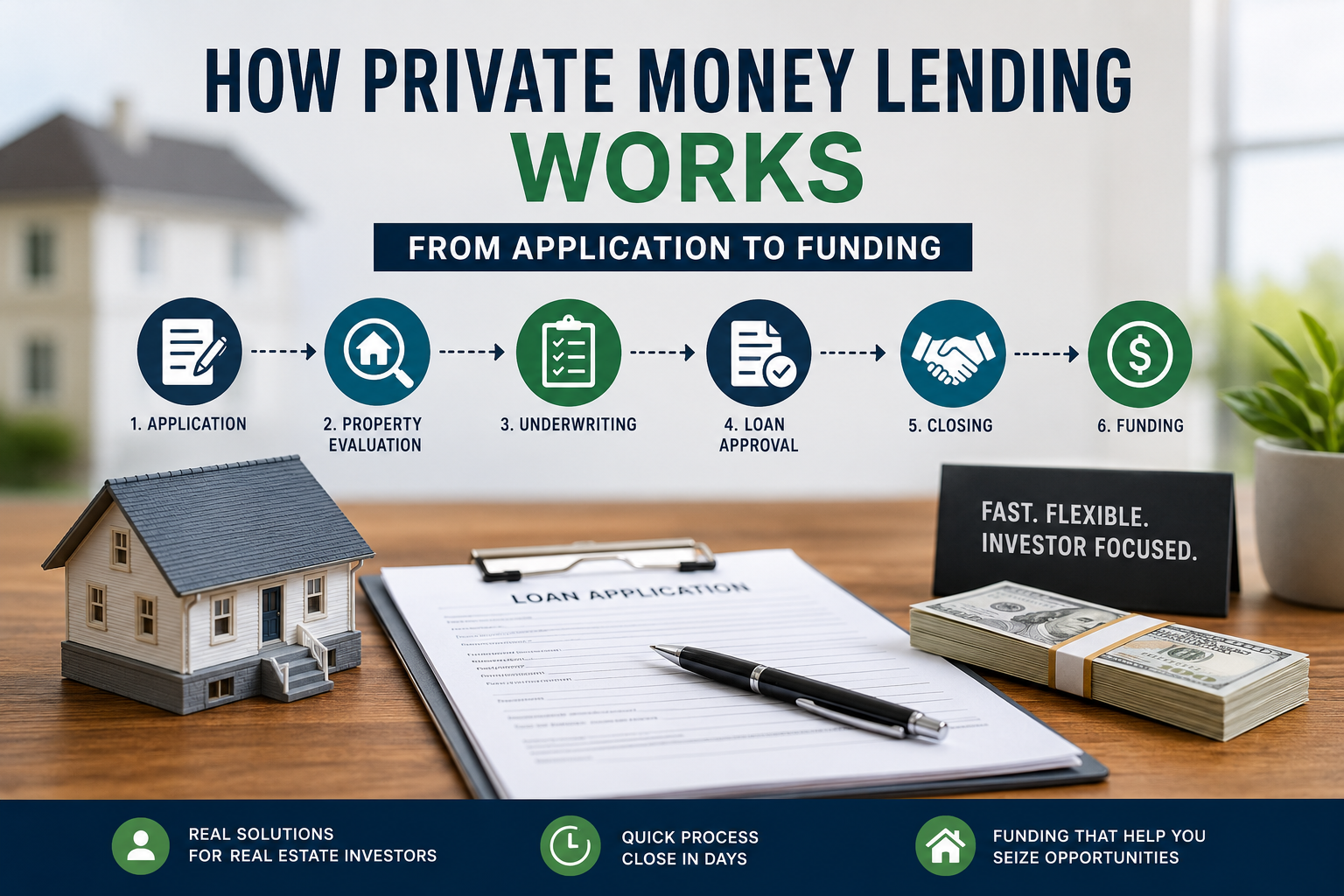
Getting funding quickly can make the difference between winning a profitable real estate deal and losing it to another investor. Traditional banks often require extensive paperwork, strict qualification standards, and weeks or even months to approve a loan. This is why many real estate investors choose private money lending for faster access to capital.
Whether you are buying your first investment property or expanding a growing portfolio, understanding how the lending process works can help you prepare, avoid delays, and improve your chances of approval.
This guide explains every step of the private money lending process from your initial application to receiving funds. You will also learn what lenders evaluate, which documents you need, and how you can move through the process smoothly.
What Is Private Money Lending?
Private money lending is a type of financing where individuals or private lending companies provide loans for real estate investments instead of traditional banks or credit unions.
A private money lender focuses primarily on the value of the investment property, the strength of the deal, and the borrower’s exit strategy rather than only looking at credit scores or personal income.
Many investors use private lending to finance:
- Fix and flip properties
- Single family rental homes
- Multifamily properties
- Ground up construction projects
- Bridge loans
- Value add commercial properties
Because approvals are often much faster than conventional financing, private money lending has become one of the most popular funding options for real estate investors across the United States.
Why Real Estate Investors Choose Private Lending
Private lending offers several advantages that make it attractive to investors.
Faster Closing
Many loans can close in days instead of several weeks. This speed helps investors compete in hot real estate markets.
Flexible Qualification
A private money lender looks beyond traditional lending requirements. Every deal is reviewed individually.
Property Focused Lending
The investment property’s value often carries more weight than the borrower’s income.
Financing for Various Property Types
Private lending can be used for residential, multifamily, mixed use, and commercial investment properties.
Flexible Loan Structures
Many lenders offer customized loan terms based on the project’s timeline and investment strategy.
Step 1: Submit Your Loan Application
The lending process begins when you complete a loan application.
Most nationwide private money lenders allow borrowers to apply online, by phone, or through a loan advisor.
During the application, you will typically provide:
- Property address
- Purchase price
- Estimated renovation costs
- Property type
- Loan amount requested
- Investment strategy
- Your real estate experience
- Contact information
The application itself usually takes only a few minutes.
Step 2: Initial Review by the Lender
Once the application is received, the lender performs a preliminary review.
The goal is to determine whether the investment fits the lender’s loan guidelines.
During this stage, the lender evaluates:
- Property location
- Property condition
- Estimated market value
- Loan amount
- Borrower’s investment experience
- Proposed exit strategy
If everything looks promising, the process moves forward quickly.
Step 3: Property Evaluation
Unlike traditional lenders, a private money lender places significant importance on the property’s value.
The lender may review:
- Current market value
- Comparable property sales
- Property condition
- Neighborhood trends
- Future resale potential
- Rental income potential
Depending on the loan program, the lender may request:
- Broker Price Opinion
- Property inspection
- Independent appraisal
- Internal valuation
The purpose is to confirm that the investment provides enough collateral for the loan.
Step 4: Review of Your Investment Plan
Private Lenders for Real Estate Investors want to understand how you plan to complete the project successfully.
Your investment plan should explain:
- Why you selected the property
- Planned improvements
- Estimated renovation budget
- Project timeline
- Expected resale value
- Expected rental income
- Exit strategy
The clearer your investment plan is, the easier it becomes for the lender to evaluate your project.
Step 5: Verify Your Experience
Not every lender requires extensive experience, but your investment background still matters.
The lender may ask about:
- Previous investment properties
- Completed renovation projects
- Rental property ownership
- Construction management experience
- Real estate licenses if applicable
First time investors can still qualify, especially when the deal is strong and the exit strategy is realistic.
Step 6: Review Financial Information
Private money lending is generally more flexible than traditional financing, but lenders still review your financial position.
You may be asked to provide:
- Bank statements
- Proof of available funds
- Identification
- Business entity documents
- Purchase contract
- Insurance information
Some lenders may also review your credit history, although it is usually not the only factor considered.
Step 7: Underwriting
Underwriting is where the lender reviews all information collected during the application process.
The underwriting team verifies:
- Property value
- Loan amount
- Investment strategy
- Borrower information
- Required documents
- Title information
- Insurance requirements
The goal is to ensure the loan meets the lender’s guidelines while protecting both parties.
Step 8: Receive Your Loan Approval
After underwriting is complete, the lender issues a loan approval.
The approval outlines important details such as:
- Approved loan amount
- Interest rate
- Loan term
- Closing requirements
- Required documents
- Funding conditions
Carefully review every term before moving to closing.
Step 9: Title Search
Before funding the loan, a title company performs a title search.
This process helps identify:
- Existing liens
- Ownership history
- Property taxes
- Legal claims
- Title defects
A clear title is important before funds can be released.
Step 10: Loan Closing
Once all conditions have been satisfied, the closing process begins.
You will sign several documents including:
- Loan agreement
- Promissory note
- Mortgage or deed of trust
- Closing disclosures
- Settlement documents
Many closings can now be completed electronically, making the process even faster.
Step 11: Funding
After the closing documents are finalized, funds are disbursed.
Depending on the loan structure, money may be released:
- As a lump sum
- In construction draws
- Directly to the title company
- To the property seller
At this stage, your investment project officially begins.
Typical Timeline from Application to Funding
Although every loan is different, many private money loans move much faster than conventional financing.
A general timeline looks like this:
- Day 1 Application submitted
- Day 2 Initial review
- Day 3 Property evaluation
- Day 4 Underwriting
- Day 5 Loan approval
- Day 6 Closing preparation
- Day 7 Funding
More complex projects may require additional time.
What Can Delay the Process?
Even with fast private lending, some issues can slow approval.
Common delays include:
- Missing documents
- Incomplete application
- Title problems
- Incorrect property information
- Delayed appraisal
- Insurance issues
- Changes to the purchase contract
Preparing documents early helps avoid unnecessary delays.
Tips to Get Approved Faster
If you want a smoother experience, consider these best practices.
Submit Complete Information
Double check every section of your application.
Organize Documents
Keep financial records, purchase contracts, and identification ready.
Have a Clear Exit Strategy
Explain exactly how you plan to repay the loan.
Be Honest
Provide accurate information about the property and your experience.
Respond Quickly
Answer lender requests promptly to keep the process moving.
What Do Private Money Lenders Look For?
Every lender has different requirements, but most evaluate similar factors.
Strong Property Value
The property should provide enough collateral.
Realistic Investment Plan
Your numbers should make financial sense.
Exit Strategy
The lender wants confidence that the loan will be repaid.
Available Cash Reserves
Having additional funds available shows financial stability.
Borrower Communication
Prompt communication helps keep the process efficient.
How Nationwide Private Money Lenders Help Investors
Many nationwide private money lenders work with borrowers across multiple states, making it easier for investors to expand beyond their local market.
Benefits include:
- Consistent lending programs
- Faster approvals
- Experience with different property types
- Flexible loan options
- Dedicated loan specialists
- Efficient online applications
This allows investors to pursue opportunities wherever they find attractive real estate deals.
Choosing the Right Private Money Lender
Not every lender offers the same level of service or flexibility.
When comparing lenders, consider:
- Industry experience
- Loan programs
- Closing speed
- Communication
- Customer reviews
- Transparency
- Property types financed
- Geographic coverage
- Fees and loan terms
Working with an experienced private money lender can make the borrowing process much smoother from beginning to end.
Common Mistakes to Avoid
Many borrowers unintentionally create delays during the application process.
Avoid these common mistakes:
- Applying before analyzing the property
- Underestimating renovation costs
- Submitting incomplete paperwork
- Ignoring title issues
- Having no clear repayment plan
- Choosing a lender based only on interest rate
- Failing to budget for closing costs
Planning ahead can save both time and money.
Final Thoughts
Private money lending provides real estate investors with a faster and more flexible way to finance investment properties compared to many traditional lending options. From the initial application to receiving funding, the process is designed to move efficiently while focusing on the strength of the property, the investment plan, and the borrower’s exit strategy.
Whether you are purchasing your first investment property or expanding an established portfolio, understanding each step of the process helps you prepare the right documents, avoid delays, and improve your chances of approval.
By working with an experienced private money lender and presenting a well planned investment, you can move from application to funding with greater confidence and focus on growing your real estate business.
Frequently Asked Questions
How does private money lending work?
Private money lending allows individuals or private lending companies to finance real estate investments. The process usually includes an application, property review, underwriting, loan approval, closing, and funding. The focus is often on the property’s value and the borrower’s exit strategy rather than only personal income.
How long does private money lending take?
Many private money loans can close within five to ten business days, although the exact timeline depends on the property, required documentation, title work, and loan complexity.
What documents are needed for a private money loan?
Most lenders request a purchase contract, government issued identification, bank statements, proof of available funds, business entity documents if applicable, property details, and insurance information. Requirements vary by lender and loan program.
Do I need excellent credit to qualify?
Not always. A private money lender may review your credit history, but many also place significant weight on the property’s value, available equity, your investment experience, and your repayment strategy.
Can first time real estate investors qualify?
Yes. Many Private Lenders for Real Estate Investors work with first time borrowers when the investment opportunity is strong, the borrower is prepared, and the exit strategy is well documented.
What properties can be financed with private money lending?
Private money lending can be used for fix and flip homes, single family rentals, multifamily properties, commercial real estate, bridge loans, and ground up construction projects, depending on the lender’s programs.
Are nationwide private money lenders available in multiple states?
Yes. Many nationwide private money lenders provide financing across several states, allowing investors to finance properties in different markets through one lending relationship.
What is an exit strategy in private lending?
An exit strategy explains how you plan to repay the loan. Common options include selling the property after renovations, refinancing into a long term loan, or repaying the loan through rental income and permanent financing.
Why do real estate investors choose private lending instead of banks?
Many investors choose private lending because it often offers faster approvals, flexible qualification standards, quicker closings, and financing options tailored to investment properties that may not fit traditional bank guidelines.
How can I improve my chances of loan approval?
Improve your chances by submitting a complete application, providing accurate property information, preparing financial documents in advance, maintaining clear communication with the lender, and presenting a realistic investment plan with a strong exit strategy.